


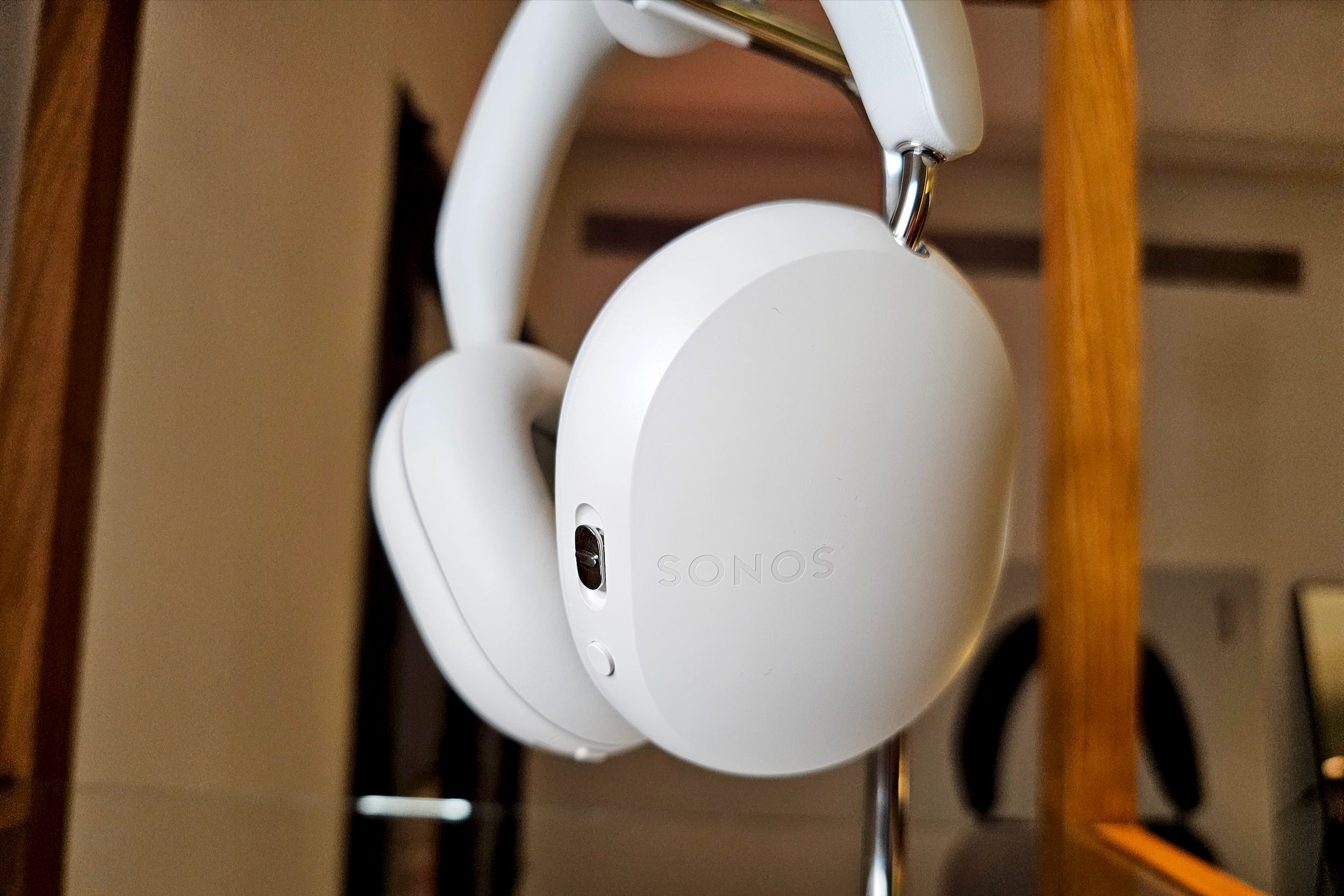
The countdown is on. Sonos CEO Tom Conrad has already hinted at a big reveal come September, and now there’s an official FCC document that confirms the existence of a product known as the Sonos Ace Ultra.
That’s cause for excitement and, maybe, just a little trepidation.
The Sonos Ace — which launched in 2024 — got a really positive reception, with reviewers like myself praising Sonos’ first headphones for their style, comfort, noise-canceling, and interface. From a hardware point of view, the Ace were a triumph.
Where things fell genuinely short of expectations was the level of integration into the overall Sonos ecosystem. With the exception of a clever toggle that lets owners of Sonos’ Dolby Atmos soundbars flip their TV sound from the speaker to the Ace and back again, the sleek wireless cans might as well have had another company’s brand etched onto the earcups.
The Ace don’t appear in the Sonos app under the System tab, where your other Sonos speakers and components are listed, and so they’re effectively cut off from every software feature that makes a Sonos product, well, a Sonos product.
As Chris Welch noted in his report for Bloomberg, this is greatly ironic given that the Sonos Ace are widely suspected to be the root cause of Sonos’ tragically flawed app redesign that rolled out less than two weeks before the Ace’s debut.
Then-CEO Patrick Spence misjudged how badly the combo would dampen overall enthusiasm for the Ace. I doubt that Conrad will make the same mistake.
So what does the Sonos Ace Ultra need to do to avoid its predecessor’s fate?
Full app integration
If it’s got a Sonos logo on it, it should be controlled by the Sonos app. Full stop. I say that knowing that this is actually much harder than it sounds.
The reality is that every Sonos product that shows up in the Sonos app is currently Wi-Fi enabled. That goes for the company’s dual-use portable speakers too (the Move 2, Roam 2, and Play). When at home, they operate on Wi-Fi and only need to be switched to Bluetooth mode when you step out the door (or out of Wi-Fi range).
Technically speaking, the current Ace model already uses Wi-Fi — it’s just been knee-capped: it serves the soundbar swap function I mentioned earlier, and that’s it.
Related:

I’ve tested a set of Wi-Fi headphones called the Hed Unity, and they worked surprisingly well. I recently learned that HiFiMAN sells two such models: Arya WiFi and HE1000 WiFi. Unfortunately, all three models pay the unavoidable price for Wi-Fi — heavily degraded battery life. When I tested the Hed Unity, I was lucky to get eight hours when using Wi-Fi, and the HE1000 reportedly lasts only five.
This, more than anything else, is likely why Sonos didn’t go full Wi-Fi for the Ace. Still, it will need to overcome this limitation or hope that customers accept it as the tradeoff for a truly integrated set of Sonos cans.
One way Sonos might be able to manage it is if it integrates Qualcomm’s XPAN technology. Released in 2023, XPAN chips marry Bluetooth and Wi-Fi into a unified structure and can switch between them seamlessly as network conditions require, according to Qualcomm. The chips are also very energy efficient, which could alleviate the stamina problem.
Sonos is already partnered with Qualcomm on the first-gen Ace, which supports Qualcomm’s Snapdragon Sound platform, so it isn’t a stretch to think that the Ace Ultra might be used as XPAN’s first mass-market headphone product (XPAN has already been used on a very limited basis in wireless earbuds).
If Sonos gets this part right, I’ll consider the Ace Ultra a serious upgrade over the Ace. But curiously, Sonos may have more up its sleeve.
Hey, Sonos
Welch points out that Sonos appears ready to lean into AI. During the company’s July 2026 earnings call, Conrad hinted at it, saying Sonos’ work on products over the past year has been “about conversational computing and predictive intelligence moving into the home.”
That could entail a lot of possibilities, but given Sonos’ investments in its own AI voice tech (Sonos Voice Control) and its proven willingness to work with third-party voice assistants like Amazon Alexa and Google Assistant, I’m willing to bet voice interaction will feature strongly in the Ace Ultra’s debut. The Ace lets you interact with your phone’s built-in assistant, but it’s not hands-free, and you can’t access Sonos Voice Control or any other AI.
But here’s the catch: Adding Alexa Plus (which Bose recently did on its new Lifestyle Ultra Speaker) isn’t going to be enough. Alexa Plus is a big improvement over Alexa, and yet, for all of its conversational skills, it still struggles with music playback tasks — the heart of the Sonos experience.
For Sonos to make a real dent in this space, it needs to demonstrate a voice AI that can quickly and accurately do anything that you can do yourself, using the Sonos app. Sonos Voice Control was supposed to fill that role, but so far, it hasn’t met that bar. Although, I gotta say, Giancarlo Esposito’s synthesized voice remains my favorite of all the voice assistants. It’s soooo smooth and sonorous.
That’s my wishlist for the Sonos Ace Ultra: Full app integration and a voice assistant that is genuinely useful. With those two features (along with everything that made the first-gen Ace so good), I think Sonos fans will have a lot to look forward to.
See you in September!
If you enjoyed this Loudmouth article, please consider subscribing. It supports my work and ensures you won’t miss out on future coverage.