



“You’ve got excellent hearing for your age,” my audiologist assures me at my annual hearing evaluation. That’s good news, though it leaves me with a nagging question: if my hearing is so good, why do I struggle to hear conversations in noisy environments?
The inconvenient answer falls into a broad clinical category called speech-in-noise processing. It describes me to a T: normal results on pure-tone hearing tests, but disproportionate difficulty in restaurants, bars, and group conversations.
Disclosure: If you buy through links on this page, I may earn a small commission at no extra cost to you. As an Amazon Associate, I earn from qualifying purchases.
Nuance Audio Hearing Glasses
Product Score: 3.5/5

Pros:
Hidden hearing aid tech
Easy to set up and use
Improves your ability to zero in on voices in noisy settings
Cons:
Tap gestures can be hit or miss
Can’t be adjusted to your face by an optician
The equally inconvenient solution has traditionally been hearing aids. Over-the-counter (OTC) hearing aids — aimed at people with mild-to-moderate loss — can help, but they come with drawbacks: I don’t love the idea of remembering to bring them, or wearing them. It’s funny how differently we treat hearing and seeing. I’ll suffer through a meal without perfect hearing, but my reading glasses always come with me. Reading a menu is non-negotiable.
An invisible fix for a common problem
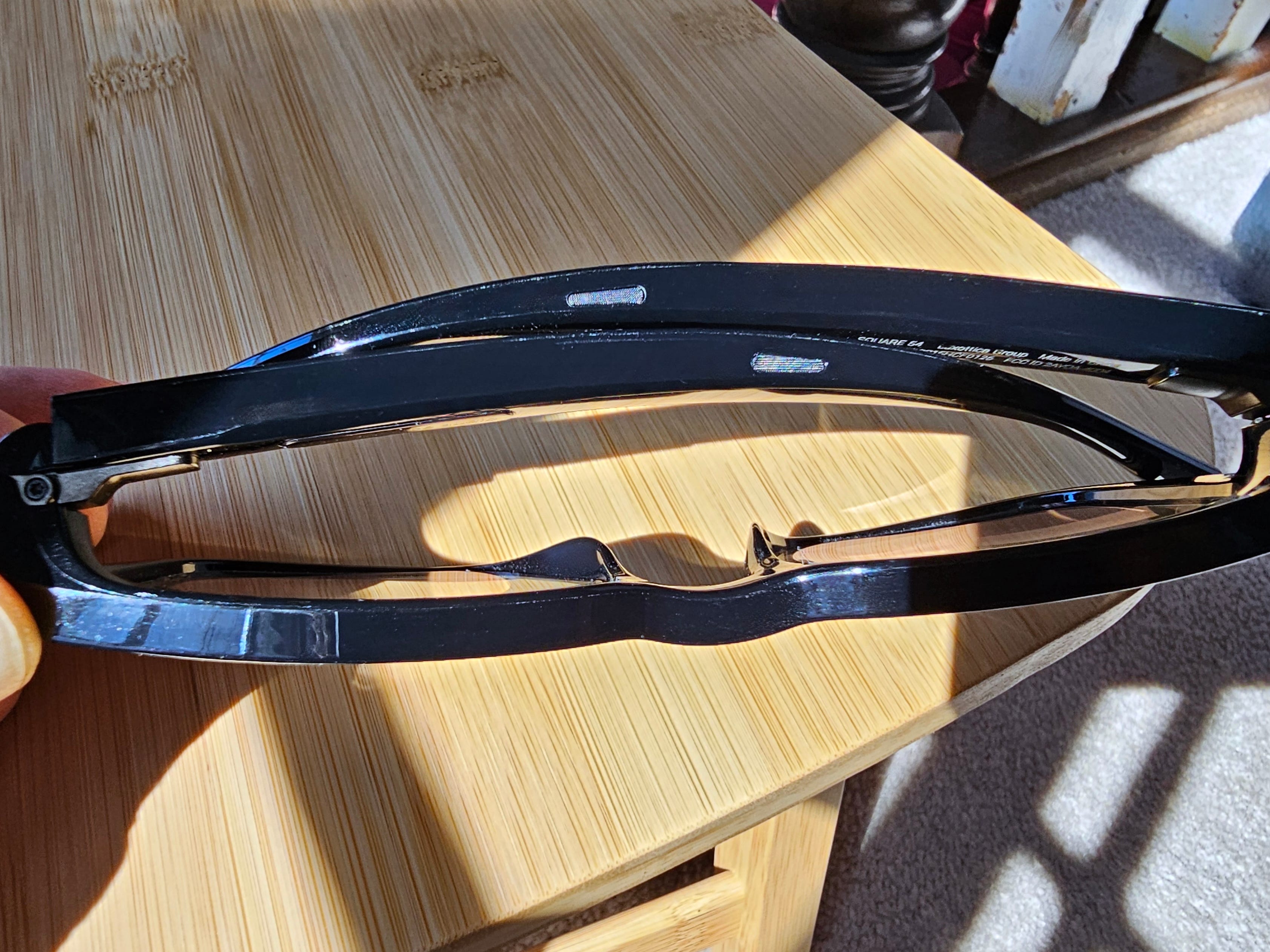
I must be part of a bigger cohort than I realized, because Nuance Audio’s Hearing Glasses appear to be exactly what I need. They look like the thick-rimmed frames you’d buy from Tom Ford, but they hide an array of microphones and tiny speakers in the limbs, positioned just in front of your ears. In theory, they provide the same hearing enhancement as a traditional set of OTC hearing aids. The FDA recognizes them as an OTC device, and they’re eligible for coverage under many insurance plans. Nuance says they’re perfect for workplace meetings, family gatherings, and, as you’ve probably guessed, restaurants and crowded places.
They come in two styles, three colors, and can be ordered with regular ($699) or prescription lenses ($1,200 and up).
The build quality is good and they’re light. The hinges are sturdy and spring-loaded, flexing outward to accommodate larger heads. They feel a little plasticky, and the piano gloss finish is a fingerprint magnet, but they don’t look cheap — no one I met knew they weren’t regular glasses. I enjoyed the looks on people’s faces when I told them.
Unfortunately, the limbs house electronics, so your optician can’t apply heat to mold them to your head. Mine slid down my nose throughout the day.


The frames use Bluetooth to connect to your phone, but only for calibration and personalization through the Nuance Audio app — a process that takes under five minutes. You can’t stream music, take calls, or make recordings. All sound processing happens onboard in real time, so your phone is entirely optional.
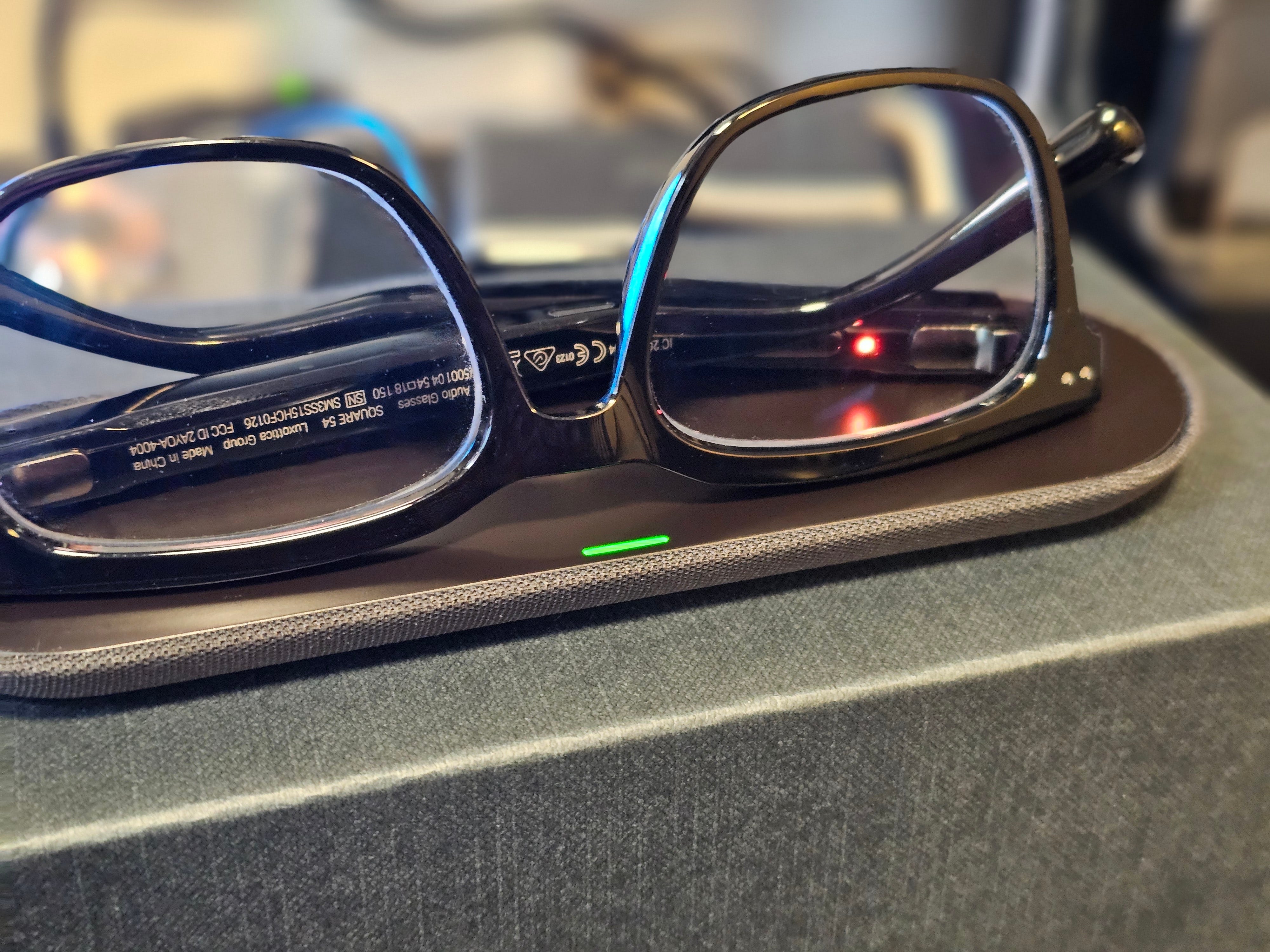
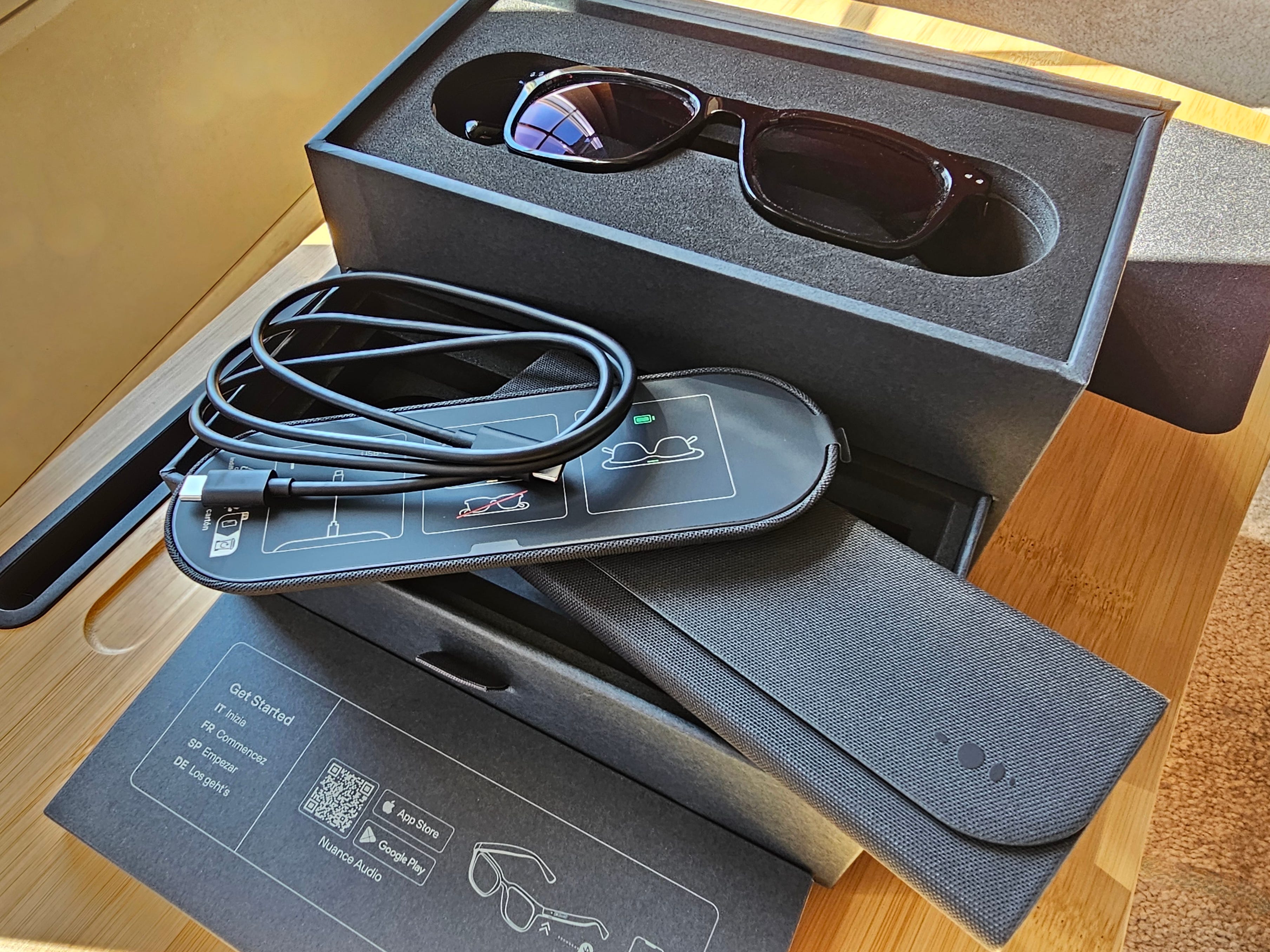
Nuance claims 8 hours of continuous use, though I got closer to 7. In the box: a carry case, lens cloth, and a wireless charging pad. The pad is sleek and USB-C powered — place the glasses upside down and magnets do the rest — but it’s one more thing to pack when traveling. Charging is slow: 5-7 hours from empty. One important warning: don’t run them under water or hit them directly with glasses cleaner. The electronics have no protection from liquids. With only a one-year warranty from Nuance, you’ll want to treat them with care.
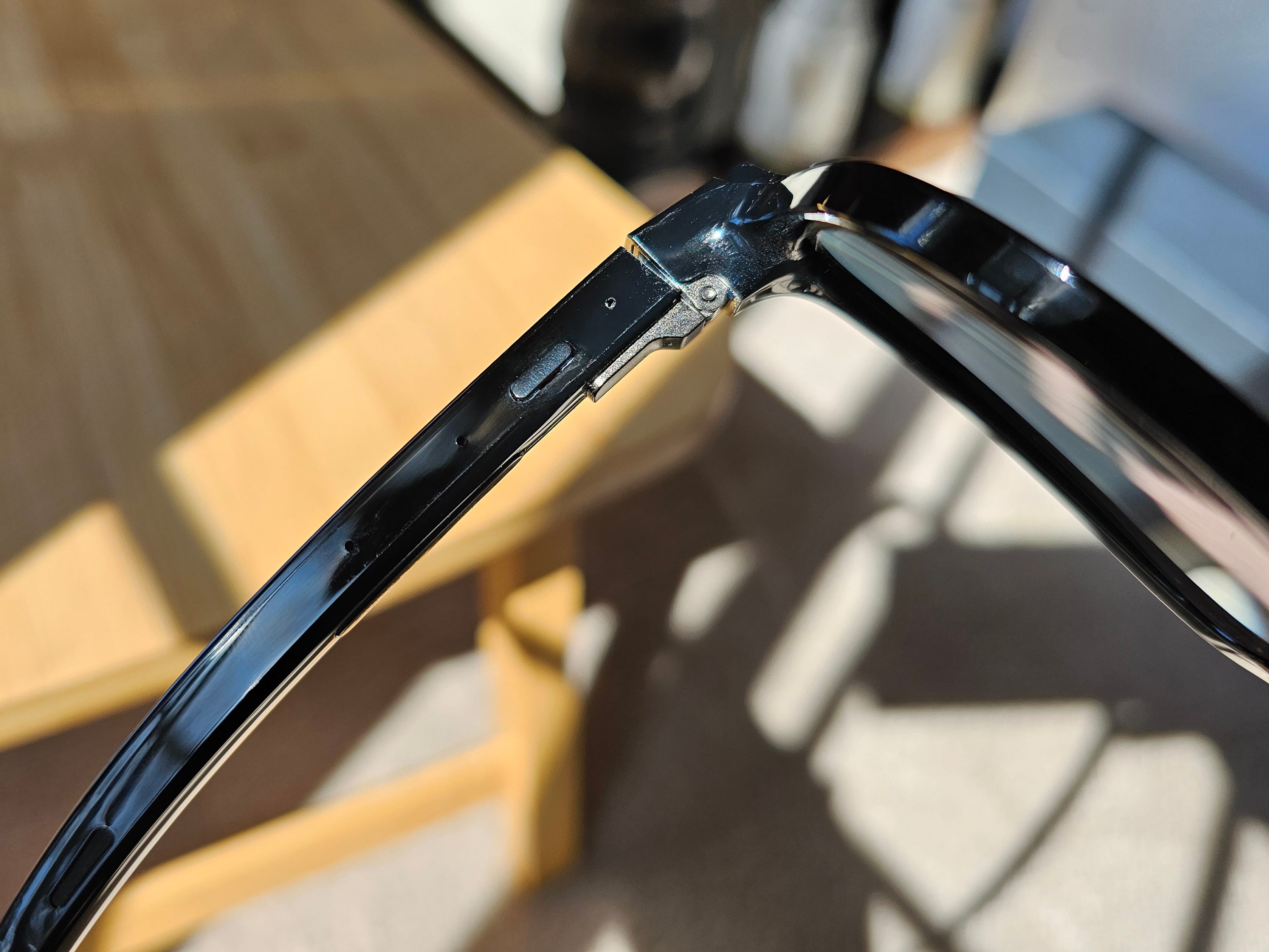
You power them on with a long press of the tiny button hidden under the right limb. Once on, that same button cycles volume between low, medium, and high. To power down, long-press again — or just fold the limbs. A double-tap on the right limb switches between two modes: Frontal and All Around.
Frontal mode is an audio spotlight: whatever you’re looking at, that’s what it tries to isolate and enhance. All Around takes a broader 360-degree sample, still targeted at voices. The lines blur in practice — Frontal will pick up surrounding voices, and All Around can lock onto an individual — so it’s up to you to figure out which works best where.
Switching modes can be hit or miss. The accelerometer is tuned to avoid accidental triggers, which means you need to tap the frames with real intent, or nothing happens.
At a recent birthday dinner in a noisy seafood restaurant, I sat at a large square table — eight of us, two per side (you need room for the oyster platter). The furthest person was 5-6 feet away. Normally I’d have missed half of what they said, but the glasses pulled their voice in clearly enough that I caught nearly every word.

I wouldn’t call it “natural.” Between the mics, the processing, and speakers too small to handle low frequencies, the sound is harsher and sharper than I’d like. Sibilance — that exaggerated ess-sound when people get too close to a mic — and a bit of echo are noticeable at times. It definitely takes some getting used to, but that’s true of all hearing enhancement products.
In restaurants, Frontal was usually the right call, especially across from a single companion. Groups were a toss-up — some voices are so hard to ignore, I wanted to turn them down, not up. What you can’t do, without opening the app, is control how much background noise gets amplified.
Some scenarios are more than the system can handle. In one especially loud restaurant, at a table of four, Frontal worked fine for the two people across from me — but to hear the person beside me, I had to twist a full 90 degrees toward him. All Around mode didn’t help; it just amplified the surrounding noise.
I’ve tried a few inexpensive OTC hearing aid products, including the Audien Atom X ($389), HP Hearing Pro ($499.99), and the hearing aid function in the Apple AirPods Pro 3 ($249.95). None of them worked as well or offered as much convenience as the Nuance Audio glasses. But their biggest drawback is that they’re earbuds, with all of the tradeoffs that earbuds require: they’re highly conspicuous, you need to remember to bring them with you, and they aren’t always the most comfortable devices to wear.
And here’s something that’s not so obvious about earbuds: pronounced jaw movements (like the kind we make while eating) have a tendency to dislodge them.
The Nuance Audio glasses aren’t a perfect solution, and at $699 to start, they’re not a casual buy. But for people who hear fine on paper and still struggle when the room gets loud, they offer an effective yet invisible helping hand.
If you enjoyed this Loudmouth article, please consider subscribing. It supports my work and ensures you won’t miss out on future coverage.
Disclosure: If you buy through links on this page, I may earn a small commission at no extra cost to you. As an Amazon Associate, I earn from qualifying purchases.